
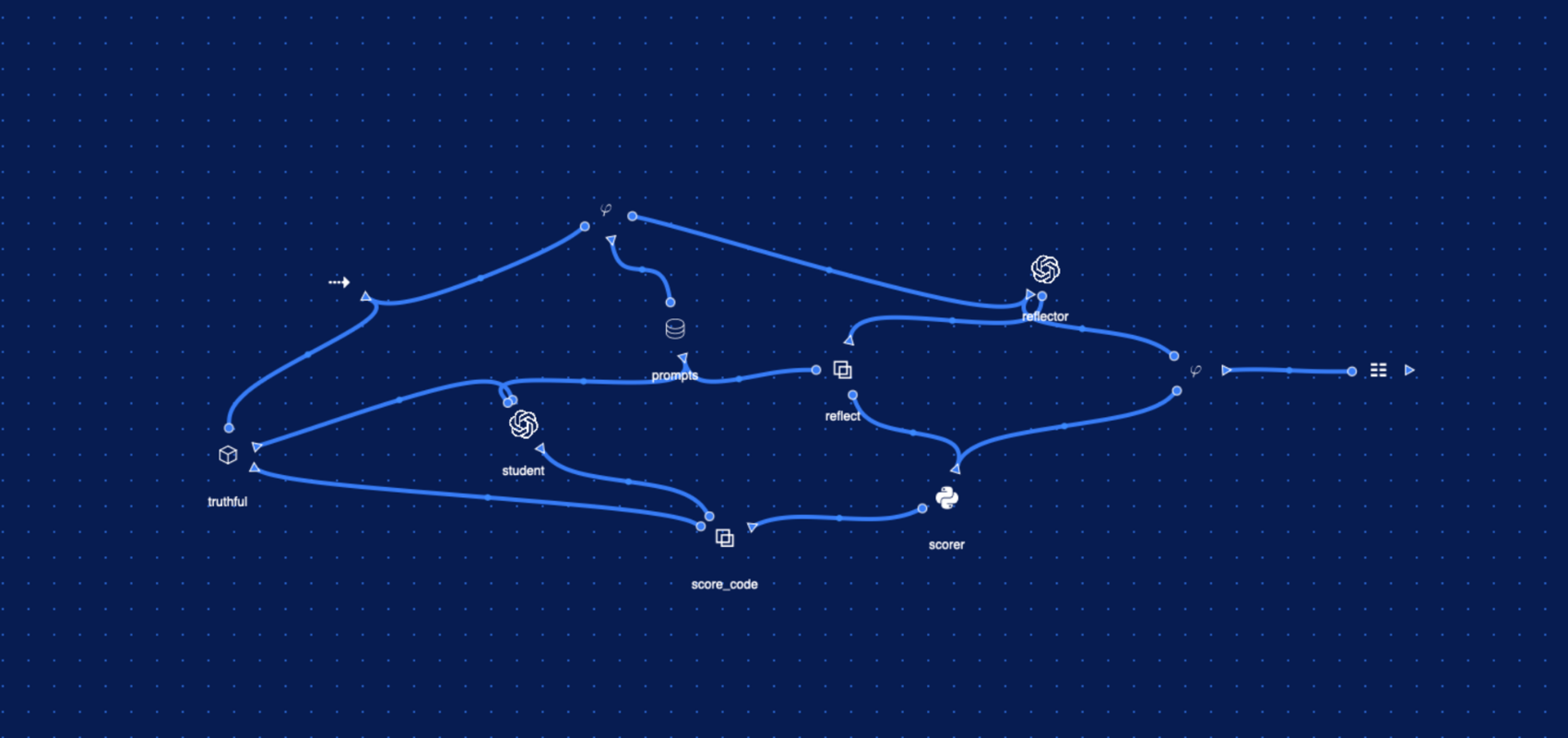
What does it take to build a substrate in which AI agents can do interesting work, and in which humans can still see what is going on? By agency we mean an interacting collection of agents, in the sense of Minsky’s Society of Mind, which prefigures much of the current orchestration literature. A working hypothesis of ours is that organisational structures of this kind are a general form of test-time scaling, and that their value lies less in what an agent computes than in giving us purchase on how it computes. This second handle is, we think, essential for doing philosophy with AI rather than merely deploying it. Two pressures, however, pull in opposite directions. We want to run research-grade agencies which involve asynchronous execution, branching, and undirected information topologies. At the same time, complex systems impose heavy cognitive loads for auditing, and the human in the loop loses any standing perspective from which to intervene, or even just understand.
HAI Lab’s Blueprint (alpha release) is a first attempt at such a substrate: a visual agent harness in which asynchronous execution and undirected flow are the design centre rather than afterthoughts. The substrate is a visual dataflow language, opinionated in the RISC tradition: a deliberately small set of atoms, each chosen so that the local choices a reader (human or agent) must hold in mind stay within subitisation range, the handful of items the visual system can apprehend without counting. The bet is that this dual constraint of minimal atom count and bounded local complexity is what makes the same diagram simultaneously a good auditing surface for a person and a good editing surface for a model. Blueprint is built to host the kinds of agencies we actually want to run in-house, including RLM-style recursive language modelling, GEPA-style prompt evolution, and AlphaEvolve-style program search, and we will continue to dogfood it against our other HAI Lab projects as it matures.